
Leadership and ownership
Name the business owner, technical owner, reviewers, approvers, and escalation path for every important AI workflow.
AccountabilityDecision rightsEscalation
AIthical.Pro Platform · Governance
Most AI risk hides in the gap between a written policy and what staff actually do. AIthical.Pro turns governance into practical decisions people can follow: what they may use, which data is allowed, where a human must review, what evidence to keep, and who owns the outcome.
Make responsible AI easier to follow in daily work, without burying the team in policies that no one can use.
A broad policy may say “use AI responsibly,” but staff still need to know which tools are approved, what information is sensitive, what output must be checked, and who can make the final call.
We connect those questions to the real work. The result is a small set of rules, controls, owners, and records that people can use.
Governance becomes part of the workflow, not a document that sits on a shelf.AIthical.Pro G.A.V.E.L.™
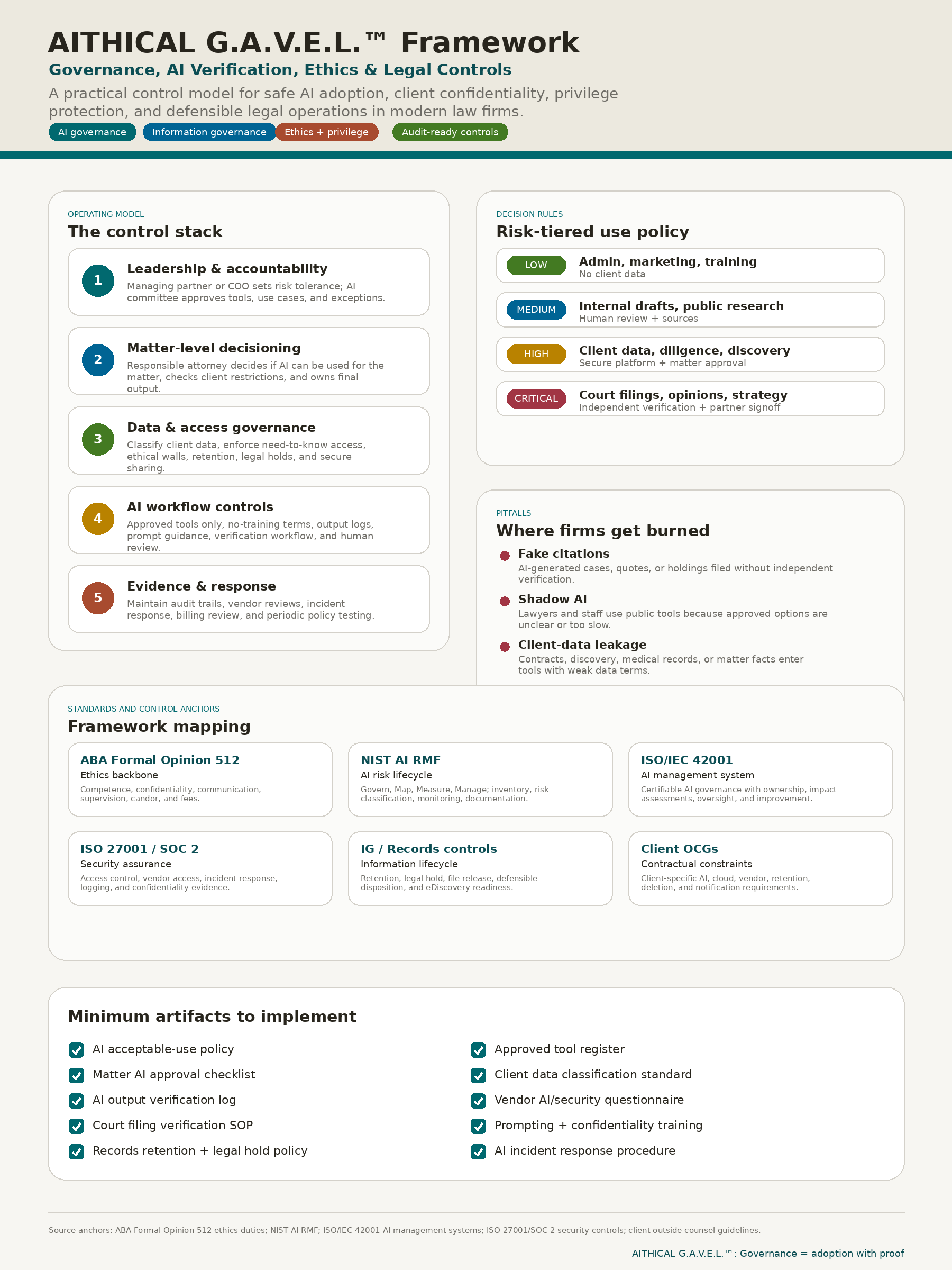
G.A.V.E.L. brings leadership, verification, ethics, legal controls, risk levels, and operating evidence into one clear implementation model.
We can map the work to relevant guidance such as the NIST AI Risk Management Framework, ISO/IEC 42001, professional rules, privacy duties, contracts, and internal policy. Mapping does not imply certification or automatic compliance.
Governance services
We keep the program proportional to your size, risk, and active use cases.
Name the business owner, technical owner, reviewers, approvers, and escalation path for every important AI workflow.
Define what is allowed, then enforce the important limits through scoped identity, tool permissions, approved destinations, review gates, and stop conditions.
Set rules for sensitive information, approved sources, network paths, retention, permissions, model providers, vendor responsibilities, and changes to the stack.
Define what must be checked, who checks it, what evidence they need, and when the system must stop and hand the work to a person.
Track agent actions, tool calls, destinations, quality, failures, exceptions, and changes, with tested alerting, credential revocation, incident response, and corrective action.
Run a law firm? Score your governance posture first: take the free AI Governance Readiness Self-Audit →
What you leave with
An acceptable-use policy, prohibited uses, approval paths, and guidance people can apply to daily work.
Active tools, workflows, data types, owners, vendors, risks, and the next decision for each use case.
Risk levels, test plans, human review, permissions, source rules, logging, and escalation matched to each workflow.
Simple reviews for new use cases, vendor changes, incidents, quality trends, policy updates, and corrective action.
The offer
AIthical.Pro turns responsible AI principles into risk levels, workflow controls, evidence, and named decisions through the G.A.V.E.L. framework.
Use-case inventory, policy and control design, evidence pack, training, and review cadence.
It takes about five minutes and shows the weakest part of the system before you book anything.
Start the assessmentFree diagnostic · about five minutes
Score the practical controls behind responsible use: inventory, policy, data, review, monitoring, and ownership. Your answers stay on this device until you choose to share the result.
Common questions
Governance, AI Verification, Ethics, and Legal Controls. It is AIthical.Pro's practical framework for turning responsible AI principles into policies, workflow controls, review steps, evidence, and named ownership.
No. G.A.V.E.L. is an implementation framework, not a law, legal opinion, or certification. We map the work to the rules and standards that matter to your organization, while your counsel and qualified advisors remain responsible for legal conclusions.
Usually not. The right starting point is a short policy, a clear inventory of active use cases, simple risk levels, named owners, and stronger controls only where the risk calls for them.
Yes. We can review current tools, shadow use, vendor terms, data flows, permissions, and workflows before recommending what to keep, change, restrict, or retire.
Good governance should help teams move with confidence. Clear rules reduce repeated debates, surprise risk, and rework. The controls should match the real risk, not create paperwork for its own sake.
We can map the work to relevant guidance such as the NIST AI Risk Management Framework, ISO/IEC 42001, professional rules, privacy duties, contracts, and internal policy. Mapping does not imply certification or automatic compliance.
G.A.V.E.L. brings leadership, verification, ethics, legal controls, risk levels, and operating evidence into one implementation model, organized into five control areas: leadership and ownership; use policy and enforced boundaries; data, sources, and vendors; verification and human review; and monitoring and response.
Clear decisions, named owners, and evidence that holds up: a plain-English acceptable-use policy with approval paths; an inventory of active AI tools, workflows, data types, owners, vendors, and risks; controls such as risk levels, test plans, human review, permissions, source rules, logging, and escalation matched to each workflow; and a simple cadence to keep it current.
Most AI risk starts in the gap between a policy and the actual workflow. A broad policy may say to use AI responsibly, but staff still need to know which tools are approved, what information is sensitive, what output must be checked, and who makes the final call. Governance should become part of the workflow, not a document that sits on a shelf.
Verification and human review are defined explicitly: what must be checked, who checks it, what evidence they need, and when the system must stop and hand the work to a person.
We will map the tools, workflows, data, owners, risks, and smallest set of controls needed to move forward with confidence.